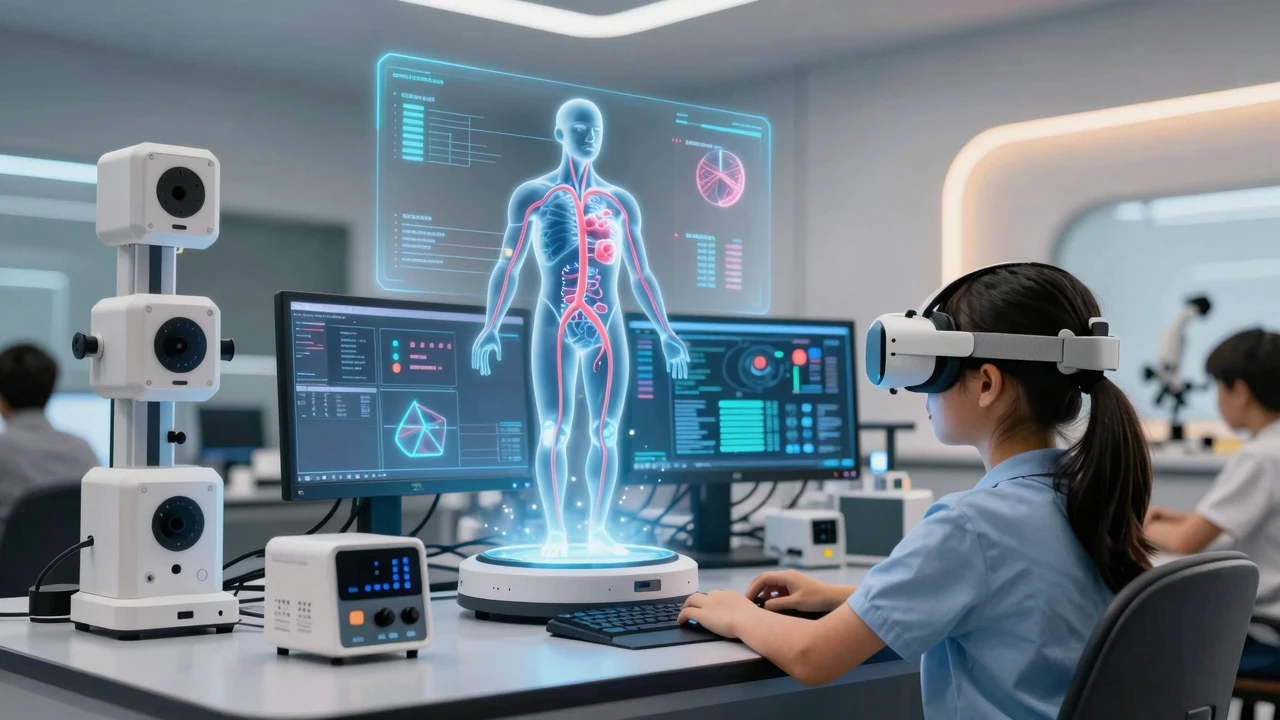
Scientific teaching aids are no longer a simple plastic model, but have been made more like "laboratories" in the classroom in recent years. In a secondary school in the capital of the North Province, students can wear a light-quantified headlight and enter a three-dimensional view of the blood cycle in a moment, while at the same vocational college in the same town, modular sensor packages can already record the temperature, pressure curves of each experiment simultaneously and directly to the teacher ' s teaching management platform. Such a scene is a precursor to future trends.

The upgrading of traditional teaching aids often requires a full set of replacements, while a new generation of programmable modules uses a standardized interface, and teachers need only replace the core control panels to allow the same hardware to support physical, chemical and even programming courses. Research by the United States ' STEAM Education Coalition in 2019 showed that the average learning efficiency of classrooms using modularized teaching aids increased by 27 per cent, while logistics maintenance costs decreased by 18 per cent.
The combination of sensors and cloud-based platforms allows each experiment to generate structured data. Teachers can view on their dashboards the students ' trajectories, error distributions, and even predict which concepts remain cognitive blind through machine learning models. An experiment at Cambridge University in 2022 showed that the teaching programme based on real-time data feedback was 0.6 standard deviations higher than the end of the traditional delivery model.
The environment is no longer just a slogan. New materials such as biodegradable resins and regenerative metal grids are gradually entering the teaching aids production line. In 2021, a laboratory in a German university of higher learning introduced 100 per cent of the chemical laboratory packages made of recyclable materials, which were sent directly to the recycling system after the experiment, and the waste rate dropped to 3 per cent throughout the year. This closed-ring design is being considered a compliance requirement by more educational institutions.
The shift from a single-disciplinary "toolbox" to an "innovation platform" to support interdisciplinary projects is already under way. An ecological facility based on open API allows third-party developers to upload experimental scripts, teaching cases and create a resource market similar to App Store. In 2020, the Shanghai City Board of Education piloted the Open Platform for Teaching Tools, which in one year accumulated 250 pilot programmes, and the proportion of student self-selections jumped from 12 per cent to 38 per cent.
"Teaching tools are not just part of teaching materials, but they are gradually taking on the central role of leading students to explore, validate, innovate."
If today's teaching tools are compared to the brushes in their hands, then ink will be changed in the future, automatically colored, and even 3-dimensional images in the air will be made by all-powerful artists. In this way, every experiment in the classroom may not be "complete and end" but an iterative process.
Participation in discussions
The holographic autopsy was interesting. Medical students don't have to line up.
Modularization is a really saver.
27% efficiency improvement? Is the source of the data reliable?
Biodegradable resins are very well-heard. What are the real costs?
The cost of maintenance is significant when it comes to procurement in school laboratories, and modularization does save much.
Education accounts for only 15 per cent of the $200 billion market.
I'm just going to have to listen to it.
The 3% wastage rate in the circular economy, and the Krauts do.