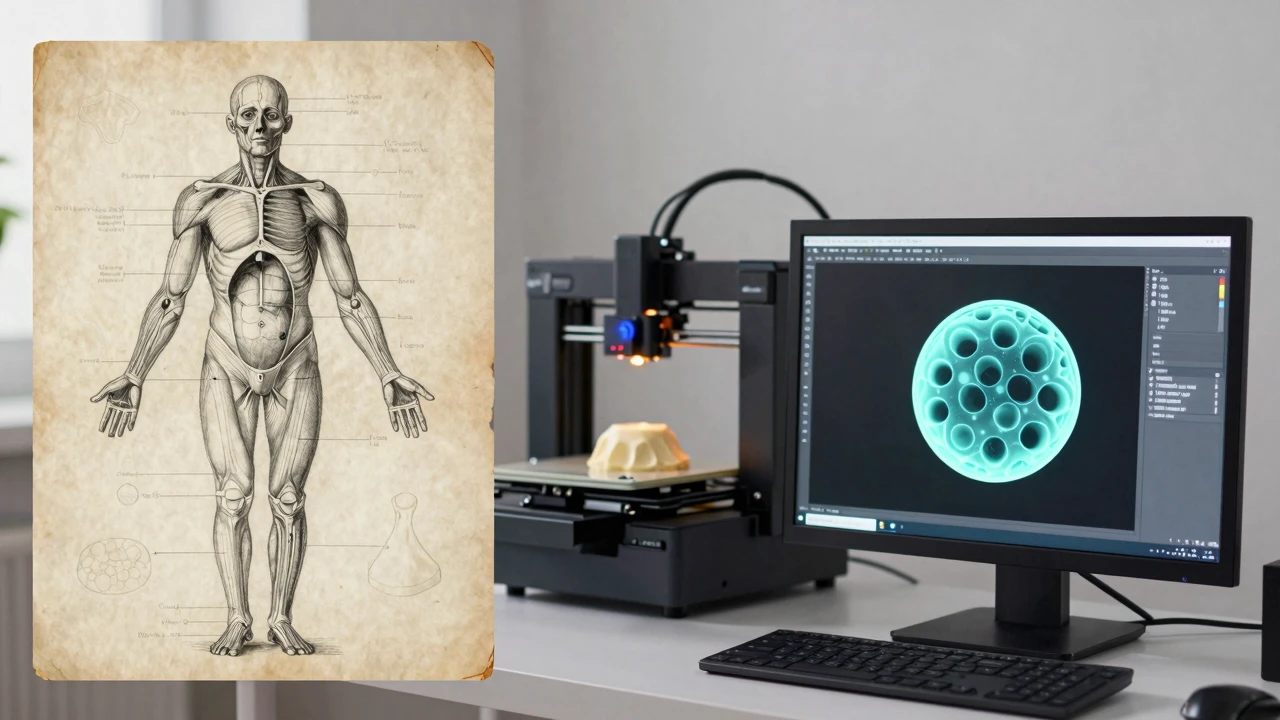
The teacher at the Zhang Jia Hong factory once showed me his baby.——It takes two weeks for each of these drawers to have a yellow bottom draft of the anatomy. This is now a specimen in the museum, replaced by a young designer who is still replicating a three-dimensional model at 2 a.m. and who can complete the digital flow line from modelling to printing in one hour.

In the 1980s and 1990s, the production of scientific teaching aids was a long-standing battle against error. In the case of human heart models, for example, technicians are required to sculpt the plaster body with a razor, which is considered to be inferior by an angle deviation of more than 2 degrees. The upper chromosomal link is more robust: acrylic paints are designed to deploy dark reds close to the autopsies, which need to be matched over and over again with colour cards, and a number of products have colour differences that are controlled by the eyes of the teacher. A complete human skeletal model with an average life cycle of 47 days from modelling to exit is documented in the technical files of an old-fashioned teaching plant, with a constant end-of-life rate of around 15 per cent.
The bottlenecks in this model are obvious. In 1998, 200 models of the nervous system ordered by a medical school in the country were collectively disfigured by hand-drawing lecturers in the neurological series, which led to a return to work in bulk, directly leading to a six-month profit payment. Artificial "non-replicability" is both a quality label and a stumbling block on the road to scale.
The transition occurred around 2010 when CAD software sunk to SMEs. The original application was simple.——A two-dimensional map is used instead of hand-drawn drafts, printed and attached to the workshop as a processing reference. The real quality change comes from the union of 3-D scans and enrichment: In 2016, the Jiangsu Institute introduced an industrial-grade CT scanning device, which directly converts fault data from real human specimens into an editable 3-D model with an aerodynamic diameter measuring accuracy of 0.1 mm, a dimension that cannot be reached by any manual technique.
More subtle changes occur at the end of the material. Traditional PVC stylists require steel moulds with a single set of costs of tens of thousands of dollars, and a modeling cycle is calculated on a weekly basis. Light solidified resins and nylon powder sintering have matured, making "no molds" a reality. Production logs of an enterprise show that the iterative testing of a new embryo development model has been reduced from 6 months in the era of modelling to 11 days, with a reduction of 87 per cent in trial costs.
It is naive and dangerous to completely phase out handcraft. Digitalization solves the "like" problem, but it still exists at the "understanding" level. I've been through a couple of head-of-the-job tests, and I've found that it's still the senior tech that's closing.——They can see at first sight the interference of the 3D printer's surface stripes with tactile teaching, and they can judge the distortion of digital colours in specific light. A factory compresses handiwork to only 3 per cent of the production process, but retains two retired old technicians, who are responsible for "the inability of the digital model to express the quality": the particle sense of the liver's surface and the fragile tension of the lung bubble.
This division of labour is reshaping the capacity structure of practitioners. In the recruitment market, the complex "with both ZBrush engraving and anatomy certificate" is paid 40 per cent higher than in a purely technical position. And the pure hand-drawer, with the exception of a very small number of non-removable protection levels, most of the "aesthetic reviser" who turned into a digital model.——Their value is no longer to do it, but to tell the machine, "It's a little off."
The current technological frontier points in two directions: first, AI-generated modelling, with the input of pathological description, to export the corresponding organ mutation model; and second, tactile feedback material, which allows students to "touch" the virtual structure on the digital screen. They haven't come out of the lab yet, but they're enough to keep the industry alert.——The ability to digitize today, proudly, is perhaps just the next intermediate to be subverted.
A transformational sample of enterprises such as CSST is, to some extent, a microslice of upgrading in China as a whole: not simply machine-to-manufacturing, but a new balance between precision, efficiency and human understanding. The drawer full of handiwork is now locked in the safe in the manager's office.——It is said to be the first production dates for a classic model.
Participation in discussions
Teacher Fauna's bottom drawer looks at my nose. There's no such thing now.
The 0.1 mm precision is a real cow, but the touch of this machine is so uncertain.
Is there any kind of teaching device that's cheap and can feel the particles?
Used to buy models that were far too colory, and now the 3D print has finally stabilized.
This business is changing too fast, and the old mechanics don't change.
Is that safe code the date of delivery? Interesting.😂
If you don't know, can A.I.'s mutation model be used directly to teach?
It takes two weeks to draw a picture, and it's done in an hour, and it's broken.
It still feels like someone has to turn it off or it's all cold plastic.
The shift in science and science is kind of a painful experience of manufacturing.
Now students are too happy to feel that fine organ model.
Are you going to the museum next time only to look at old yellow drawings?