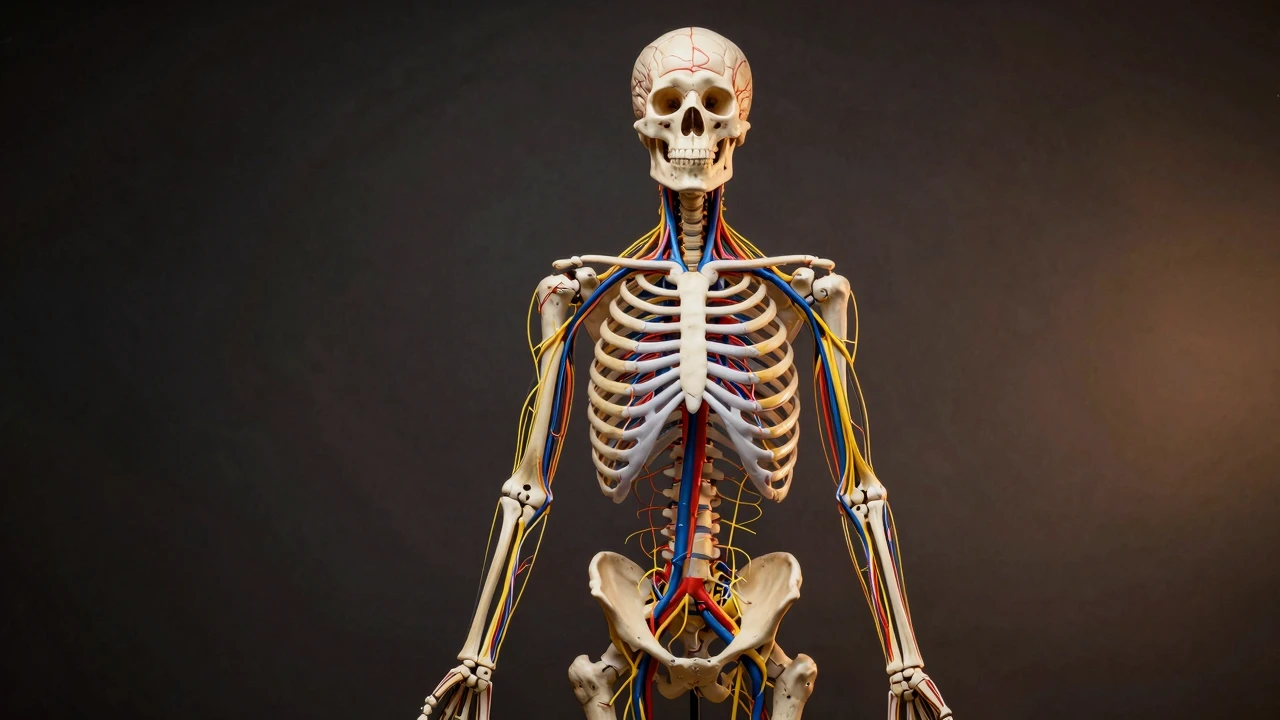
Picking up a 170-centimetre neurovascular skeletal model, the first thing you see is not the bones, but the colour cables that surround them.——Red arteries, blue veins, yellow nerves. These colours are not randomly painted, and they follow an extremely stringent set of anatomy code rules.

The model is based on a complete skeleton of 206 bones. The skull can be disassembled, the jaw can function and the arms and legs can move through metal links. But what really keeps this skeleton alive is another system attached to it.
Manual wear is the key word for this. Every neurological beam, every vascular, is fixed by the worker in a crochet-by-section hole for the bone. That explains why a good model lasts ten years.——The direction of the cable itself is a simulation of the point of attachment of the real band, and the mechanics structure determines the durability.
Yellow cables represent the nervous system and are the most prone to error in modelling. In the case of the neurological arms, it exits from the side of the cervical vertebrae, enters the armpit through an oblique cleavage and then branches the upper limbs. If the walk position is even two centimetres above the model, a cognitive deviation occurs when the structure is identified on the operating table after the medical birthday.
Twelve pairs of brain-neurological holes in the base of the skull are another precision test. Sniffing nerve through sieves, optic nerve tube to hold the optic nerve, round hole walking up the cynic.——These bone lanes must be modeled in a way that accurately corresponds to the cables of the respective colours. Some high-end models can even structure sponges inside the skull, so that the immediate proximity of the artery and the outreach nerve is visible.
The distribution of red, blue and bicoloured blood vessels is essentially a truncated story of human circulation. The active bow sends a stem of the head, the total left neck, the lower artery of the left collarbone, and the decrease in the diameter ratio of these three red branches in the model directly reflects the true blood flow distribution priority. The large hidden veins of the lower limbs are particularly large in blue because they are the longest shallow vein of the human body and the most commonly used vascular material in coronary bridging operations.
Interestingly, modelers deliberately leave an intensive vascular net inside the pelvic cavity to show the blood supply of the larvae to the bladder and uterus.——Anatomy in the region is highly variable, and a slight inactivity in the operation is a haemorrhage. The colour density on the model, to some extent, implies a level of clinical risk.
The bone structure is a map, the blood vessels are a river, and the nerve is a communication cable laid along the river. The three fold together to constitute anatomy that can be truly read and understood.
Participation in discussions
Looks like he's big.
How much is 170 centimeters of home?
A lot of cheap models are walking right now, and students can be misleading when they practice.
I've moved this in the lab before.
Red and blue and yellow are good. Otherwise, it's a mess.
Feels like an alien. It's kind of creepy.
Is that pelvic vascular net really that complicated? How can you tell the difference during surgery?
It's very nuanced.
hh, it feels like an autopsy.
A lot of it's made out of machines.
What is this model made of?
Someone finally made the rules clear.
It feels like muscle models are harder than this.
A whole month of freshman anatomy with this model.
I can't read, but I think it's professional.